by April Dinwoodie
TRJ Executive Director
Growing up as a mixed-race Black child adopted into a white family, the holidays were full of excitement — the lights, the treats, the special once-a-year traditions.
But they were also exhausting.
Exhaustion from wondering about my family of origin.
Exhaustion from not seeing myself reflected anywhere around the table.
Exhaustion from hearing racially or culturally insensitive comments from extended family members.
Exhaustion from pretending everything felt the same for me as it did for everyone else.
What I needed wasn’t more gifts —
it was more understanding.
More curiosity.
More emotional support.
More space for all of who I was.
As I plan for the holidays this year and revisit the principles of Kwanzaa, I’m reminded that this celebration offers more than cultural practices — it offers a framework. A way of thinking. A grounding tool for families formed through adoption.
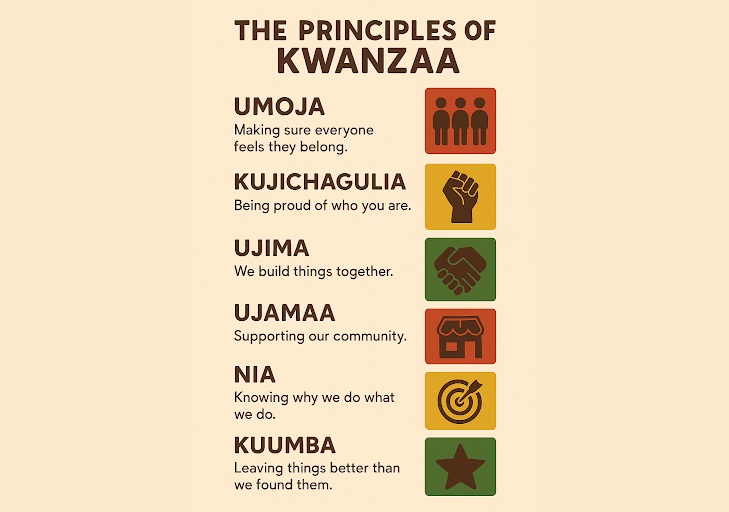
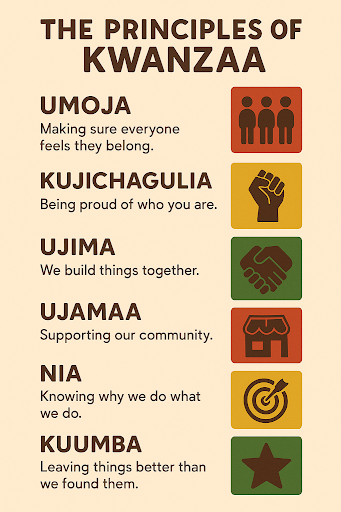
Created by Dr. Maulana Karenga, the seven principles of Kwanzaa — the Nguzo Saba — offer a meaningful structure for connection, reflection, and building family practices that honor identity and belonging.
Kwanzaa isn’t something to “add on.”
It’s something that can support us.
It helps families reflect, reconnect, and remake traditions with intention.
And the best part?
You do not have to do all seven principles perfectly.
You can return to them every year, adjusting as your child grows and your family evolves.
Every family is at a different point in their journey.
The work is simply to stretch as far as you truthfully can toward deeper belonging.
Here’s how each principle can gently guide you.
NGUZO SABA FOR ADOPTIVE FAMILIES
(The Seven Principles of Kwanzaa, created by Dr. Maulana Karenga)
1. Umoja — Unity
Meaning: Making sure everyone feels they belong.
Adoption Lens: Unity grows when every child’s identity is honored.
Practice: Ask: “What helps you feel included during our holidays?”
2. Kujichagulia — Self-Determination
Meaning: Being proud of who you are.
Adoption Lens: Let children express and shape their identities openly.
Practice: Explore new holiday traditions and invite children to choose one that reflects their culture or interests.
3. Ujima — Collective Work & Responsibility
Meaning: We build things together.
Adoption Lens: Traditions don’t have to be inherited — they can be co-created.
Practice: Hold a quick “Holiday Check-In”:
What stays? What shifts? What’s something new we create?
4. Ujamaa — Cooperative Economics
Meaning: Supporting our community.
Adoption Lens: Community helps children feel culturally anchored.
Practice: Choose one local Black-owned, Indigenous-owned, or culturally relevant business to support together.
5. Nia — Purpose
Meaning: Knowing why we do what we do.
Adoption Lens: Traditions should support identity and connection, not pressure or performance.
Practice: Ask: “Why does this tradition matter? Whose story does it tell?” Adjust with intention.
6. Kuumba — Creativity
Meaning: Leaving things better than we found them.
Adoption Lens: Creativity helps families navigate complexity and build meaningful rituals.
Practice: Create or adapt one holiday ritual that honors your child’s culture, family of origin, or personal truth.
7. Imani — Faith
Meaning: Believing in ourselves and each other.
Adoption Lens: Children need adults who trust their truths and hold hope for their futures.
Practice: Offer this affirmation:
“All of who you are belongs here.”
As a child, I didn’t have language for what felt missing.
But I knew what belonged — and what didn’t.
This year, let Kwanzaa be an invitation. A tool. A path forward for families willing to stretch toward honesty, identity, and belonging.
Because when adoptive parents do even small things to honor the fullness of children.
when they create traditions with them instead of for them — the exhaustion can soften.
And that is the work of remaking what matters.
Practical Tips for Parents
(Choose one or two — a little truly goes a long way.)
✨ Start small. Pick one Nguzo Saba principle to explore this year.
✨ Be honest with yourself. Notice where traditions limit belonging.
✨ Invite your child in. Even one question opens connection.
✨ Adjust as you go. Holidays should evolve with your child’s needs.
✨ Revisit yearly. Belonging grows in layers, not all at once.
✨ Stay curious. Curiosity is more important than getting it “right.”
Most of all:
Stretch as far as you truthfully can — your effort builds a child’s bright path to belonging.
This post is from our December 2025 newsletter. If you would like to get our newsletter in your inbox each month, as well as information about our annual TRJ Family Camp and our monthly Zoom call providing support for our transracial adoption parents, please subscribe.