by April Dinwoodie
TRJ Executive Director
When I was growing up, my mom would always say a beautiful and simple Thanksgiving prayer. Every year, we’d close our eyes, hold hands, and listen to her voice rise and fall. The smell of turkey filled the air, and for a few moments everything felt still. I remember feeling thankful—surrounded by love, warmth, and the familiarity of family.
But I also remember the ache—the quiet wondering. My family of origin was never mentioned among the members of the extended family who were missing and prayed for. I thought of them every year. Were they celebrating too? Did they wonder about me the way I wondered about them?
Now, looking back, I realize that we were closing our eyes in more ways than one. We were closing our eyes to the family that wasn’t there, and to the history of the day itself—the story of this country, the Indigenous lives and legacies that were disrupted, the realities of what was taken and what was lost.
That unspoken tension—the both/and of Thanksgiving—has always lived inside me. The deep thankfulness for what I have, held right alongside the awareness of what’s missing and what must be named.
November and the Table of Truth
As we move into November, which is also National Adoption Awareness Month, the family table takes on even deeper meaning. It becomes a mirror—a place where stories of legacy, history, and belonging meet. For adoptive and especially transracial adoptive families, the holiday table can hold layers of love, difference, and longing all at once.
At Together on the Journey, we know that the table is more than a piece of furniture. It’s a symbol of connection and story. Who gathers around it—and who is missing—tells us a lot about how we understand family.
In my childhood home, we didn’t have words for that complexity, but I felt it deeply. The silence around my family of origin matched the silence around the history of Thanksgiving. Both were wrapped in good intentions, but both left important truths unspoken and left me to navigate the difficulties silently.
This year, instead of closing our eyes, let’s open them together. We can be thankful for the people around us and honest about the people and histories that are missing. We can hold thankfulness and truth at the same table.
Try this:
When it’s time to share what you’re thankful for, add a second invitation:
- “What has been hard this year?”
This simple act can open space for honesty, empathy, and connection—reminding everyone that joy and difficulty can live side by side.
Expanding the Story of the Day
For some, Thanksgiving is a treasured family ritual. For others, it’s a reminder of pain and loss. Both truths can coexist. We can be thankful for the love we share while also being mindful of the full story of this day.
Consider how your family names and frames the holiday. Maybe you call it A Day of Thanks and Truth, Harvest Gathering, or simply Family Day. Learn about the Indigenous peoples whose land you live on. Talk about what was taken, not just what was shared. These small shifts don’t erase tradition—they expand it. They help children entrusted to you see that thankfulness and awareness can live together.
Telling the Truth Beautifully
For adopted people, the holidays often carry that same blend of joy and longing. Parents may want to make the day perfect, but what children often need most is honesty, not performance. Sometimes the most loving thing we can do is say out loud what everyone already feels.
Maybe that means lighting a candle for a family of origin. Maybe it’s saying, “We’re thankful for those who can’t be here,” and letting that sentence mean many things. It might even mean sitting in quiet reflection, acknowledging both the family gathered and the family unseen.
Making Space for the Whole Story
Every family has its own rhythm, its own version of the both/and. For some, it’s thankfulness and missing pieces. For others, it’s pride and pain, belonging and uncertainty. The goal isn’t to fix or smooth those feelings—it’s to let them breathe.
When we make room for all of it, we teach our children that they don’t have to choose between being thankful and being honest. They can be both.
Try this:
If something hard comes up during the holiday, take a breath before responding. You don’t need the perfect words.
- A simple “I hear you” or “That makes sense” can be enough to open connection and build trust.
A Table of Thankfulness and Truth
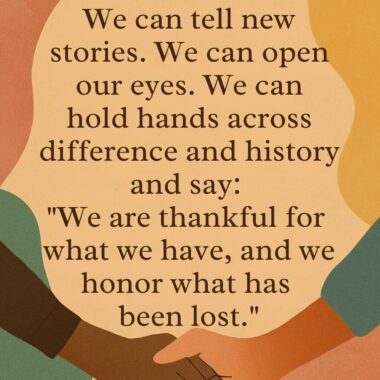
When I think back to those moments of my childhood—the prayer, the warmth, the silence—I wish we had found words to hold the fullness of our experience. But now I know that each of us can begin again. We can tell new stories. We can open our eyes. We can hold hands across difference and history and say:
- “We are thankful for what we have, and we honor what has been lost.”
That’s the table I want us all to set together now—a table where love and truth sit side by side, and where everyone, past and present, has a place.
Reflection Prompts for Families
- What truths about Thanksgiving and adoption have been left unspoken in our home?
- Who is at our table—and who is missing?
- How can we honor both thankfulness and truth in the way we gather?
- What new names, rituals, or stories might reflect our family’s values more fully?
This post is from our November 2025 newsletter. If you would like to get our newsletter in your inbox each month, as well as information about our annual TRJ Family Camp and our monthly Zoom call providing support for our transracial adoption parents, please subscribe.