Kwanzaa, Adoption, and the Work of Remaking What Matters

by April Dinwoodie
TRJ Executive Director

Growing up as a mixed-race Black child adopted into a white family, the holidays were full of excitement — the lights, the treats, the special once-a-year traditions.

But they were also exhausting.

Exhaustion from wondering about my family of origin.
Exhaustion from not seeing myself reflected anywhere around the table.
Exhaustion from hearing racially or culturally insensitive comments from extended family members.
Exhaustion from pretending everything felt the same for me as it did for everyone else.

What I needed wasn’t more gifts —
it was more understanding.
More curiosity.
More emotional support.
More space for all of who I was.

As I plan for the holidays this year and revisit the principles of Kwanzaa, I’m reminded that this celebration offers more than cultural practices — it offers a framework. A way of thinking. A grounding tool for families formed through adoption.

Created by Dr. Maulana Karenga, the seven principles of Kwanzaa — the Nguzo Saba — offer a meaningful structure for connection, reflection, and building family practices that honor identity and belonging.
Kwanzaa isn’t something to “add on.”
It’s something that can support us.
It helps families reflect, reconnect, and remake traditions with intention.

And the best part?
You do not have to do all seven principles perfectly.
You can return to them every year, adjusting as your child grows and your family evolves.

Every family is at a different point in their journey.
The work is simply to stretch as far as you truthfully can toward deeper belonging.

Here’s how each principle can gently guide you.

NGUZO SABA FOR ADOPTIVE FAMILIES
(The Seven Principles of Kwanzaa, created by Dr. Maulana Karenga)

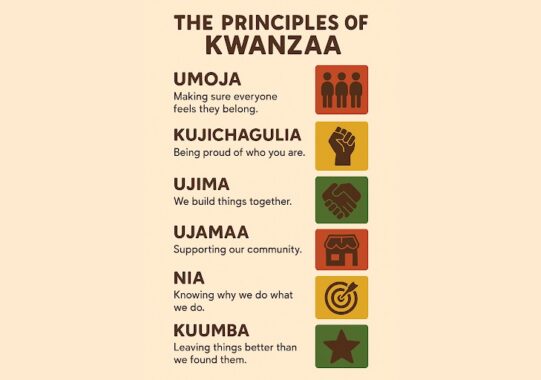
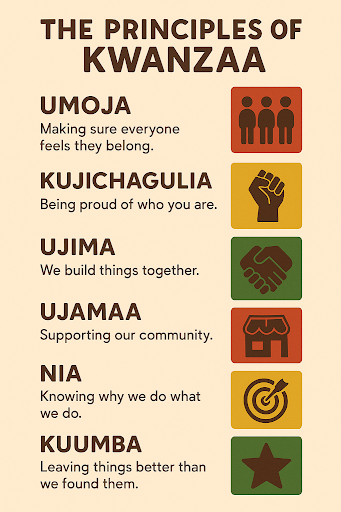
1. Umoja — Unity
Meaning: Making sure everyone feels they belong.
Adoption Lens: Unity grows when every child’s identity is honored.
Practice: Ask: “What helps you feel included during our holidays?”

2. Kujichagulia — Self-Determination
Meaning: Being proud of who you are.
Adoption Lens: Let children express and shape their identities openly.
Practice: Explore new holiday traditions and invite children to choose one that reflects their culture or interests.

3. Ujima — Collective Work & Responsibility
Meaning: We build things together.
Adoption Lens: Traditions don’t have to be inherited — they can be co-created.
Practice: Hold a quick “Holiday Check-In”:
What stays? What shifts? What’s something new we create?

4. Ujamaa — Cooperative Economics
Meaning: Supporting our community.
Adoption Lens: Community helps children feel culturally anchored.
Practice: Choose one local Black-owned, Indigenous-owned, or culturally relevant business to support together.

5. Nia — Purpose
Meaning: Knowing why we do what we do.
Adoption Lens: Traditions should support identity and connection, not pressure or performance.
Practice: Ask: “Why does this tradition matter? Whose story does it tell?” Adjust with intention.

6. Kuumba — Creativity
Meaning: Leaving things better than we found them.
Adoption Lens: Creativity helps families navigate complexity and build meaningful rituals.
Practice: Create or adapt one holiday ritual that honors your child’s culture, family of origin, or personal truth.

7. Imani — Faith
Meaning: Believing in ourselves and each other.
Adoption Lens: Children need adults who trust their truths and hold hope for their futures.
Practice: Offer this affirmation:
“All of who you are belongs here.”
As a child, I didn’t have language for what felt missing.
But I knew what belonged — and what didn’t.
This year, let Kwanzaa be an invitation. A tool. A path forward for families willing to stretch toward honesty, identity, and belonging.
Because when adoptive parents do even small things to honor the fullness of children.
when they create traditions with them instead of for them — the exhaustion can soften.

And that is the work of remaking what matters.

Practical Tips for Parents

(Choose one or two — a little truly goes a long way.)
✨ Start small. Pick one Nguzo Saba principle to explore this year.
✨ Be honest with yourself. Notice where traditions limit belonging.
✨ Invite your child in. Even one question opens connection.
✨ Adjust as you go. Holidays should evolve with your child’s needs.
✨ Revisit yearly. Belonging grows in layers, not all at once.
✨ Stay curious. Curiosity is more important than getting it “right.”

Most of all:
Stretch as far as you truthfully can — your effort builds a child’s bright path to belonging.

This post is from our December 2025 newsletter. If you would like to get our newsletter in your inbox each month, as well as information about our annual TRJ Family Camp and our monthly Zoom call providing support for our transracial adoption parents, please subscribe.
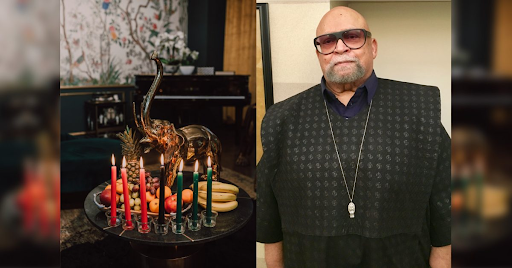
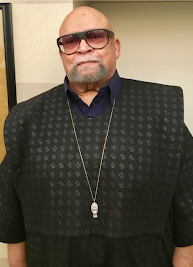
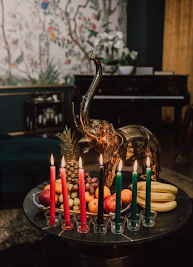
Black Excellence – Dr. Maulana Karenga

🕯️ Dr. Maulana Karenga: A Tradition of Self-Determination in the December Holidays

The end of the year invites reflection on our most cherished traditions. For the Black community, this reflection is often rooted in the dynamic legacy of Dr. Maulana Karenga, the scholar and activist who gifted the world with Kwanzaa in 1966. His creation is the ultimate example of an evolving tradition, offering a profound cultural framework for African Americans to celebrate themselves, their history, and their future during the December holiday season.

Kwanzaa, celebrated from December 26th to January 1st, was established in the aftermath of the 1965 Watts Rebellion in Los Angeles. Dr. Karenga conceived of the holiday not merely as an observance, but as an act of cultural recovery and reconstruction.

At its core, Kwanzaa was a conscious decision to evolve the holiday landscape. It was created to provide a non-religious, pan-African alternative and complement to existing December celebrations, allowing African Americans to root their end-of-year gatherings in collective values and African heritage.

"My goal was to 'give black people an opportunity to celebrate themselves and their history, rather than simply imitate the practice of the dominant society.'" - Dr. Maulana Karenga

The foundational structure of Kwanzaa is the Nguzo Saba (The Seven Principles), a set of communitarian values drawn from African philosophy. These principles perfectly embody the idea of expanding our thinking and actions, transforming abstract ideals into a seven-day commitment to community building:

Day 1 Umoja: Unity - Family, community, nation, and race.

Day 2 Kujichagulia: Self-Determination - To define, name, create, and speak for ourselves.

Day 3 Ujima: Collective Work & Responsibility - To build and maintain our community together.

Day 4 Ujamaa: Cooperative Economics - To build and profit from our own businesses together.

Day 5 Nia: Purpose - To restore our people to their traditional greatness.

Day 6 Kuumba: Creativity - To leave our community more beautiful and beneficial than we inherited it.

Day 7 Imani: Faith - To believe in our people and the righteousness of our struggle.

By dedicating each day to a principle, Kwanzaa actively fosters a tradition of reflection, self-affirmation, and collective action. It is a powerful cultural tool that helps families take a closer look at what traditions mean to us—shifting the focus from commercialism to ethical and communal values.

While originally conceived as an alternative to Christmas, Kwanzaa has matured into a celebrated and integrated part of the African American holiday experience. Many families choose to celebrate both holidays, weaving the cultural strength of the Nguzo Saba into their religious or secular Christmas observances.

Dr. Karenga's work has had a lasting impact by:

  • Providing Cultural Grounding: Offering a tangible way for people of African descent to connect with their ancestry and culture during the festive season.
  • Encouraging Self-Definition: Living up to the principle of Kujichagulia (Self-Determination) by having a holiday created by and for the Black community.
  • Fostering Unity: The emphasis on the Kikombe cha Umoja (Unity Cup) and the culminating feast (Karamu) on December 31st reinforces the essential communal spirit.

Dr. Maulana Karenga’s Kwanzaa remains a monumental example of Black excellence, demonstrating that the most enduring and meaningful traditions are often those we have the courage to create for ourselves.

Black Excellence Posts:

Each month, we take time to highlight the remarkable contributions of Black leaders, trailblazers, and changemakers whose impact continues to shape our world. These stories serve as a valuable opportunity for transracial families to learn, reflect, and engage in meaningful conversations about Black history and culture. We invite you to explore our past Black Excellence features in the carousel below, where you’ll find inspiring figures from various fields—activism, science, arts, sports, and beyond. If you haven’t already, be sure to subscribe to our monthly newsletter to receive these stories, along with discussion prompts and book recommendations, right in your inbox.


December – Reflections: Evolving Traditions 

The December holidays give us an opportunity to think about traditions tied to different cultures and religions. Regardless of what you and your family honor and celebrate, we can be inspired to take a closer look at what traditions mean to us and how we can expand our thinking and actions.

Read this month's reflection as well as previous December posts from over the years to help guide you and your family through the ideas of evolving traditions:

December Pro-Tip to Foster Conversations About Transracial Adoptions

At Transracial Journeys we send out cues for conversations each month. Our Transracial Journeys card deck contains 3 cards for each month that the children use to ask their parents questions. Below are the questions for December. Before getting started, read the parent pro-tip each month.

December Pro-Tip for Parents: Resist the urge to hold tight onto traditions that may be holding you back from fully embracing new ideas that may better honor your child’s culture. Also think about simplifying or modifying some of the traditions you now honor to make room for new ones.

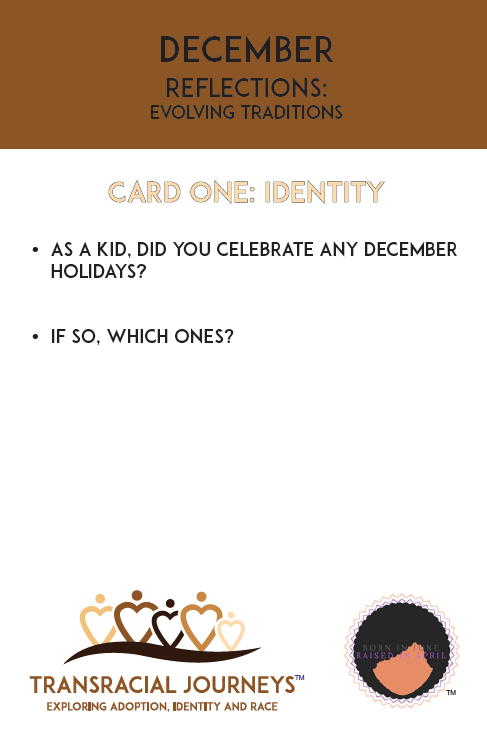
CARD ONE: IDENTITY
• As a kid, did you celebrate any December holidays?
• If so, which ones?

CARD TWO: RELATIONSHIPS
• Were there things that you would do year after year as a family during the month of December or maybe other months of the year?

CARD THREE: EMBRACING AND FACING DIFFERENCES OF RACE AND CULTURE
• What are some new traditions or holidays you’d like to learn more about and/or try?

This post is from our December, 2025, e-newsletter. If you would like to get our newsletter in your inbox each month, please subscribe.


Book Corner – December 2023

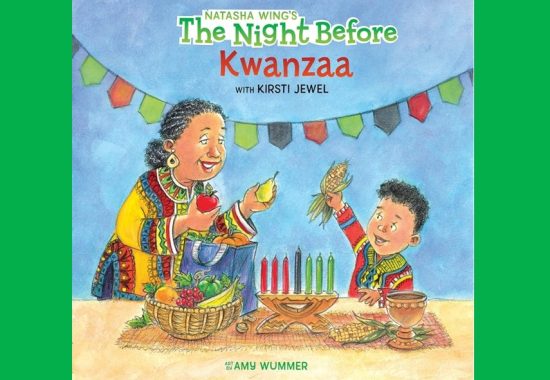
The Night Before Kwanzaa

By Natasha Wing
Illustrated by  Amy Wummer and Kirsti Jewel
Pre-kindergarten - Grade 2 

A young boy is excited for the arrival of his older brother. He is looking forward to celebrating Kwanzaa with him and the rest of their family. As a candle is lit on the Kinara each night, simple (yet heartwarming) illustrations depict the accompanying seven principles of Kwanzaa.

There is a familiarity in this sweet book as it may remind older readers of “The Night Before Christmas” - one of the most well-known poems about the holiday.

This is a recommended read for multicultural families as it blends an old tradition (reading the old poem) with new ones (celebrating the principles of Kwanzaa).

Books for Transracial Families

Book Recommendations for Families Created in Transracial Adoption

The Book Corner is a regular feature in our Transracial Journeys monthly newsletters. If you would like to receive monthly book recommendations via email, please subscribe.


Creating New Traditions to Reflect Our Families and Celebrate Their Identities

author: Avril McInally

For many of us, holidays can be a combination of many emotions and elements. Do we have all the candles we need for our Menorah or for our Kinara? Have we gotten our holiday lights and decorations up? How are we managing our budgets? Is the house tidy and clean enough for our house guests? Do we have enough food? Speaking of food, what about those special recipes we need to prepare? Do we have all of the proper ingredients? And the gifts? Did we purchase enough gifts to make sure no one is left out or one child gets more than another? These are the scenarios for many families at Hanukkah, Christmas, Kwanzaa or Yule, yet what of our families? Our families manage these aforementioned holiday traditions of hosting, eating and gifting as well as creating space for our adopted children, their race, the family they were born into, their culture, their religion and more!Read our previous post: ‘Tis the Season to Reminiscence

Because our families represent multiple aspects of identity, heritage, and culture, we visit the idea or concept of intersectionality. Some intersectionalities that help to describe our families include race, gender, sexuality, adoption, age and religion. We have several aspects of intersectionality to honor, celebrate, foster and sometimes protect. There’s a little more “juggling” for us to do to manage these precious aspects of our children’s and family’s identities. One way to celebrate “us” is to create new traditions that reflect our families and honor their identities. Read our post about the conversation cards this month December - Reflections: Making and Breaking Traditions 

Traditions can be a way for families to connect and memorialize important life events. To adoptive families, creating traditions is more than a way to bond, but it can also be a great way to commemorate each family member’s roots. By incorporating activities that celebrate birth culture, adopted children can develop a strong sense of identity.

This year, I’m going to work on creating a holiday card for our family with my family. I’ll make a list of our intersectionalities with my adult daughters. Black, White, Adopted, Not Adopted, Atheist, Immigrant, American, Cisgender, Female, Male….. You get the picture. Then, we’ll draw a Venn diagram of our family’s identity and decorate it. Heck yeah, “This is Us”! This is who we are with some holly on top! This could be a new holiday tradition for us. If you start this tradition now with young children, you can save your cards every year and watch how your lists morph or mature.

In addition to creating and honoring traditions, it’s important to make time to honor our extended family of adoption as we gather to eat a special meal, to light a candle, to build a fire on one of the longest nights of the year or simply when we tuck our children into bed at night. Remember it’s important to honor and/or acknowledge the family members absent from your home. It’s the “most wonderful time of the year,” yet at the height of festivities and anniversaries, our children may be experiencing loss and sadness. Make space for children who are processing these emotions and thoughts and love on ‘em a little more and give them space to talk about their feelings. And last but not least, you may also have emotions surrounding losses or complexities that can come up as well.  Building a tradition of inclusion, empathy and love starts with tending to ourselves!

This post is from our December, 2022, newsletter. If you would like to get our newsletter in your inbox each month, please subscribe.


Book Corner – December 2022

BOARD BOOKS

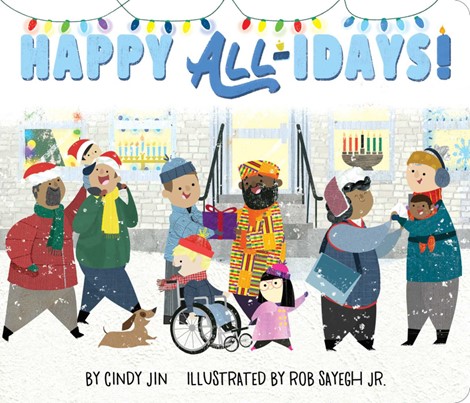
Happy All-Idays:

By Cindy Jin, illustrated by Rob Sayegh Jr.

“We all celebrate the season in our own special way.
Let’s look at how families prepare for each holiday.”

With a double-page spread for each holiday, this inclusive book shows families enjoying Christmas, Chanukah, Kwanzaa, and Chrismukkah.  Ending with Season’s Greetings and Happy New Year, Happy All-Idays is a celebration for everyone.

Merrytale:
A Christmas Adventure

By Christopher Franceschelli, illustrated by Allison Black

On Christmas Eve two brown children are invited on an enchanting adventure.  They ride on a dog sled through the forest and across the ice to Santa’s workshop, where they meet a diverse group of elves who are baking, making toys, singing, wrapping, and more.  Children will love lifting the flaps, turning the shaped pages, and finding all the magical details in this fun book.

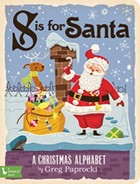
S is for Santa:
A Christmas Alphabet

By Greg Paprocki

From A is for Angel and B is for Baking, to Y is for Yummy and Z is for Zephyr (a toy train), this book is an alphabet of holiday fun.  The illustrations have an old-timey feel, but are delightfully populated with people of every hue.  A joyful depiction of Caroling, Ice Skating, Mistletoe, Volunteering, and more.

PICTURE BOOKS

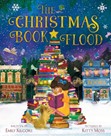
The Christmas Book Flood

By Emily Kilgore, illustrated by Kitty Moss

This beautifully illustrated book is based on a real tradition in Iceland.  Each year people give books as gifts on Christmas Eve, and the recipients spend the night reading.  They snuggle under blankets, eat chocolate bars, and drink hot cocoa.  The lovely art in this book depicts all kinds of people searching for just the right books for their loved ones, gifting them, and reading together. The wonderful tradition of Book Flood is starting to spread around the world.  Reading this book together would be a great way to introduce it to your family and friends!

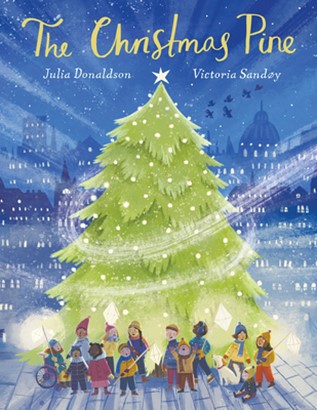
The Christmas Pine

By Julia Donaldson, illustrated by Victoria Sandoy

This lovely book also celebrates a wonderful tradition.  Every year Norway sends a spectacular Christmas tree to England as a symbol of peace and friendship.  Each year a poem is written to welcome the tree to London.  The Christmas Pine is the poem that was written for the 202o tree.  The touching text and illustrations show the tree’s journey from the forest to the ocean to Trafalgar Square.  There are happy diverse groups of people on both ends of the journey. A sweet book for family sharing around the Christmas tree.

The Hanukkah Hunt (Ruby Celebrates!)

By Laura Gehl, illustrated by Olga and Aleksey Ivanov

Avital is sad because her mom will be far away during Hanukkah.  Cousin Ruby plans a treasure hunt to cheer Avital up.  Each night of Hanukkah there is a rhyming clue, which leads to a fun surprise.  The final clue leads to the best surprise of all – Mom is back in time to celebrate the last day of the holiday.  This story of a loving multi-racial family is followed by an explanation of Hanukkah and directions for playing Dreidel. 

NONFICTION

My Family Celebrates Kwanzaa

By Lisa Bullard, illustrated by Constanza Basaluzzo

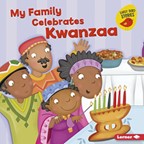
Kevin and his mom get the table ready for Kwanzaa, and then the celebration begins.  They light a candle each night, talk about the Seven Principles, and have a party.  Readers will learn about Kwanzaa as they enjoy the holiday with Kevin and his family.

Kwanzaa, How to Celebrate it in Your Home

by Kathleen Minnick-Taylor, illustrated by Charles Taylor II

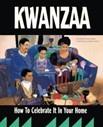
Kwanzaa is an African American cultural holiday that began in 1966.  This book is an accessible and handy guide to celebrating the seven principles of the holiday.  For those of us who attended camp in 2022, this is the guide we used to celebrate Kwanzaa at our dinner times.

Book Recommendations for Families Created in Transracial Adoption

Our Transracial Journeys families regularly seek out books to share with their children and to read for themselves, as white parents of black children. We are fortunate to have a resource in the Transracial Journey's Board of Direcors Secretary, Avril McInally. With a Master of Library Science from Kent State University and over 35 years as a public librarian, Avril and her colleague, Vicki Richards, collaborate to curate phenomenal book recommendations for our children and parents.   The Book Corner is a regular feature in our Transracial Journeys monthly newsletters. If you would like to receive monthly book recommendations via email, please subscribe.